The Clark News Vol. 2, No. 7 p25-28
1960Grantsville, Utah1 page
Transcription
p25
Day Book of John Anderson
I was born in Viken, Animskog County in the Province of Dalsland, Sweden the 22 of October, 1835. My father was an agriculturist, and I was brought up by my father to follow in the same line of endeavor. In my younger days I used to watch over my father’s animals in the forest but when I reached 12 years of age my parents moved to Osterbyn Westore in Genta County in Dalsland (moved between 1846-49). There was my father bought a ¼ of a large farm. From the time I was 12 years old I worked very hard as a farmer in all different lines, pertaining to such activity. I worked along with my father and all of his enterprising turned out well. Father’s financial situation became very good indeed, due to the untiring effort, daily labor and diligence displayed by him and my five brothers. We all lived at home and unitedly worked to remodel the house and care for the property. We were a very congenial family.
In the year 1860 my father and mother and all my five brothers and my sister and I heard the Gospel and accepted it. The 22nd of October 1860 through a tree [unclear] baptized, and during the next two years twenty-one of our relatives stood ready and joined the church. On the 13th of April 1862 seventeen of our relatives stood ready to leave the city of Gothenburg and Babylon to travel to Zion. Among those seventeen were my father and mother, my oldest brother Anders, my brother Carl, my brother Gustav and myself. The family of my mother’s brother numbering eleven made up the remainder of the group.
From the time October 22, 1862 when mother and I listened to and obeyed the voice of the gospel, there was much persecution, especially for me, for I was the first among my brothers to join the church. I had been given the priesthood and had the opportunity to baptize my sister. I had taken charge of the sacramental and so on. All this was too much for Lucifer. Five times I was called to the local priest and also to a Bishop’s meeting. I was later brought before the Judge and given the sentence of 28 days imprisonment on bread and water. But the Lord saved me from this hardship, inasmuch as my father had sold his property and we stood ready to leave for Zion before the time had been set for me to begin the sentence. They could not stop me from obtaining bond. This was given to me by Brother Anders Borgeson. He also was persecuted for the same reason as I,—and
(Continued from page 25)
given the same sentence. When time came for my prison term to begin I was out of there, somewhere on the Atlantic Ocean, Brother Borgeson, however served out his sentence.
At the October conference in the year 1873, I was called to go on a mission to Sweden. I left my home in Grantsville the 19th of October. Left Salt Lake City the 20th at 6 A.M. Arrived in Chicago the 23rd of October, and came to New York City the 25th. Our steamship left November 1st. We had salon place on board. The fare was 80 dollars in gold. They gave us the price of 40 dollars in greenbacks, as we were eighteen in our company; all called as missionaries to different countries in Europe. We had excellent quarters on the boat, and our voyage across the Atlantic ocean was altogether pleasant. Arrived in Liverpool November 12, at 9 A.M. Left in a couple of hours for Hull, arriving there that evening at 6 P.M. There we went on board another ship, which brought us to Hamburg, and from there to Copenhagen, Denmark. On the 21st Elder Winge and I left Copenhagen by boat for Gothenburg in Sweden. Our trip was marred by a bad storm that night. But we finally arrived in Gothenburg in fair shape. The first thing we did was to look up Elder Lindelov, who was branch president there. We visited with some of the Saints there, till I left by railroad and came to Stockholm the 27th of November. I remained there till December 14th when I left for Uppsala where I visited with members and missionaries. Spent Christmas there. On December 31st Elders Oblad and Karlgren, and I left for Moenby Bruk where we spent New Year’s day, and held two meetings. We continued to travel and hold meetings, and visited the following places: Brytna, Nyhyttan, Vergsbo, Hedemora, Malmkoping, Sparreholm, and were back in Stockholm the 28th of January. On the eleventh of February I traveled to the Province of Dalsland, where I had the opportunity to visit relatives and friends from my early youth. The old church in Gretna looked old and small to me now. I went from place to place visiting and bearing my testimony, and holding meetings. On the 16th of June I left Stockholm again, this time by boat, headed for Sundsvall in Northern Sweden. I traveled around and sold many books and tracted and bore my testimony to the people, who treated me well. On the 24th of June, which was midsummer, we had a little meeting in Sundsvall in the forenoon and also the afternoon. After which we all went to a forest where the saints had arranged for a picnic. The next day we baptized the Rudelin family. Elder Sundstrom and I left for Ostersund a few days later. On this trip we slept out of doors several times, fighting the mosquitos. Occasionally we would sleep in a barn. We kept right on walking in the country from place to place, sometimes we found it easier to follow the railroad tracks. We visited many small towns and villages always preaching the Gospel and holding meetings wherever possible.
On July 29th I started missionary work in Stockholm and presided over that branch till November 28th, 1874. Then N. C. Flygare was called to preside. I was called again to preside over the Stockholm branch in June 1875. A month before this time we had an unusual experience in Fallingsbro. We felt very humble and fasted and prayed for wisdom and strength to go forward in righteousness and holiness before the Lord. We besieged him to strengthen Karolina Brig, who had been bedridden for nearly five years. Her body had shrunk from her long and painful illness. She had become a member of the church eight months before this time, and because of her condition could not be taken out of the house to be baptized. So a large tub was brought inside for her baptism. On the 16th day of May we administered to her. We could feel the power of healing from the Lord, and she was made well instantaneously, and got up and prepared a meal for us. We all rejoiced together.
In the winter of 1862 I was ordained a Seventy, and in the year 1882 at a conference in Tooele, October 28th and 29th, I was called to be a member of the High Council of Tooele Stake of Zion. I was ordained a high Priest and set apart for this calling at a priesthood meeting in Grantsville, November 4th, 1882, by Apostle Lyman. I was released from the High Council at a conference in Tooele, June 11th, 1905.
Citizenship Note
John C. Anderson became a citizen of the U.S. of America, July 26, 1871. Appeared in the 3rd Judicial District Court of U.S. in territory of Utah. Signed Wm. A. Walker, Clerk.
Johannes (John C.) Anderson was married to Mary Ann Clark on May 4, 1867. He took the name of John C. after he came to America; the C. coming from his wife’s maiden name of Clark.
Charlotte Rachel Anderson Smith
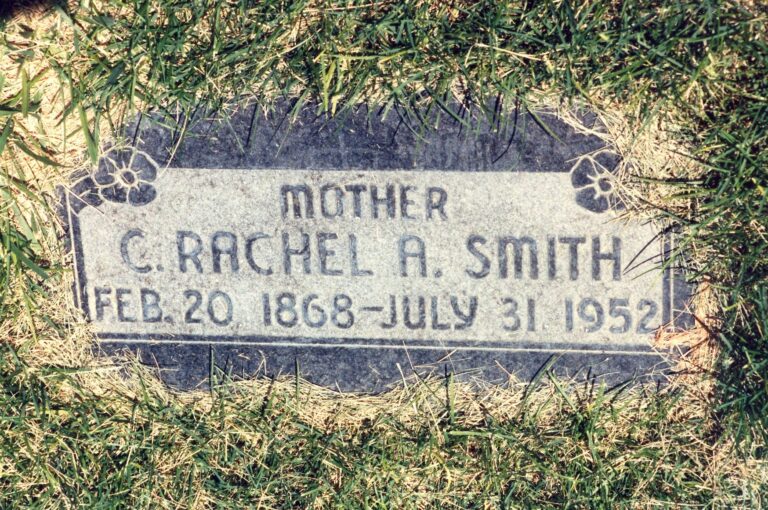
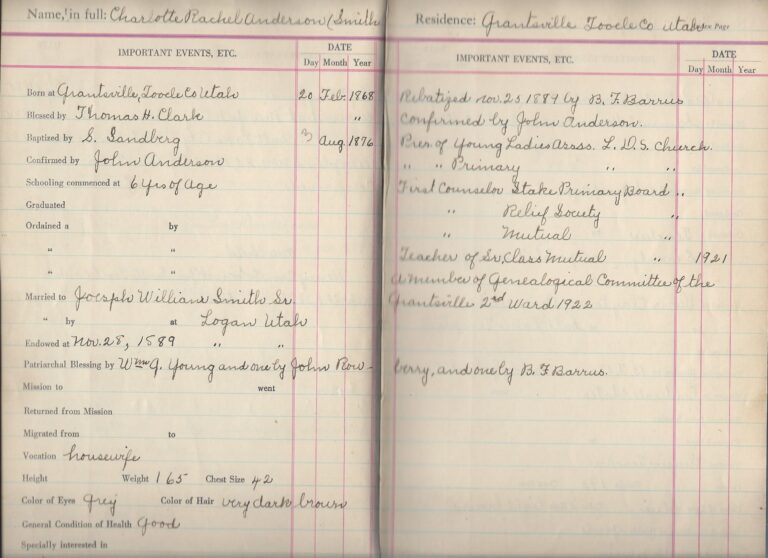
Charlotte Rachel Anderson Smith, daughter of John C. Anderson and Mary Ann Clark, was born February 20, 1868 in Grantsville, Utah. She was baptized in the month of August 1876. Rachel was the eldest of a large family which made it necessary for her to work in the fields with her father during harvest time. Even when she was very young her responsibilities in the home were many. In her early youth she was president of the Young Women’s M.I.A., and before the Ward was divided she taught a class in religion.
On November 28, 1889 in the Logan Temple, Rachel and Joseph W. Smith were united in marriage. They were blessed with eight children. From early days of responsibility until she passed away Rachel was a steady and hard worker, always active in the church. She served as president of the primary in 1902 and two years later was made first counselor of the Stake Primary. Later Rachel served as First Counselor to Relief Society in the Primary Stake Board, which position she held for fourteen years.
During the flu epidemic Rachel devoted time and service to the sick. She did nursing under the direction of Dr. Freeman who praised her for her fine work and untiring services. All the help that Rachel did at the time of the influenza epidemic was free. She never accepted a cent from anyone even though she had very little and worked hard to earn a living for herself and children. As a member of the Genealogical Committee she did a great deal of Temple work, and after the wards were divided was a counselor to Relief Society in the Second Ward Relief Society.
Rachel was a true daughter of the Pioneers and inherited sturdy qualities that helped her overcome the difficulties that came during her lifetime, and they were many. She held no self pity for the sorrows that came her way, and when she was left a widow with
(Continued from page 25)
two children she took in washing to support them and herself. She did not leave home for outside work, as she was a firm believer in mother’s staying at home with their children. Wash water was heated in large tubs on coal stoves in those days and one of her daughters recalls some times doing as many as five family washings in one day during the summer months.
The Smith home was a very humble one but overflowing with a warm welcome for every one. All her life Rachel deprived herself of all types of luxury to give to others, but she deplored any thing that was ragged or unkempt. She was always clean and tidy and kept her kitchen stove so shiny the grandchildren could see their faces in it. Thrifty and yet generous, she was a great and lasting influence to these grandchildren. They remember her keen sense of humor and her many sage sayings such as “Don’t try to be a 15¢ dude on a 10¢ salary.” Independent to the last few weeks of her life, she lived alone and took care of her home and self, with her last thoughts being always of any burden she might become to others. She left a great heritage to her posterity and will ever remain as an example to her children and grandchildren.
—Submitted by Beverly Stromberg, grand-daughter of Rachel Smith.
Rachael and Joseph had eight children:
– Joseph William, August 29, 1891;
– Ellen Ann (Helen Orr), May 13, 1893;
– John Franklin, July 13, 1894;
– George Stephen, April 27, 1896;
– Henry, April 1, 1898;
– Rachael Amelia (Palmer), October 2, 1901;
– Homer Legrande, May 21, 1904;
– Alice (Nelson), May 17, 1908.
History of Mary Ann Clark Anderson, Daughter of Thomas Henry Clark and Charlotte Gailey
Mary Ann’s parents were born in Herefordshire, England. They spent their early life there and were married in 1825 and continued to live in Bishop Frome Herefordshire, England. Two sons and five daughters were born to them here. The family belonged to the Methodist church, but in 1840 Thomas Henry became dissatisfied, as did several hundred others, and they organized a group called “The United Brethren.” Thomas Henry was a traveling Minister in this group.
In January, 1840, Elder Wilford Woodruff, who was an LDS missionary in England, had a presentiment to go to the southern part of England to hear two men souls waiting to hear his message. Elder Woodruff made the trip to southern England and in a short time baptized over 600 people into the Church; the Clark family being among this group. From that time on Thomas Henry was a traveling Elder.
April 6, 1841, the Clark family left their native land, crossing the ocean on the ship “Catherine” and arriving in Nauvoo July 8, 1841, after having been on the way three months. Their home in Nauvoo was in an old blacksmith shop without windows and no door.
(continued from page 25)
Thomas and his son John William worked on the old Mansion House of Nauvoo. For payment of their labors they had to take such produce as they could obtain, and in small quantities. The family was able to have but one kind of food each day. During these days they endured many hardships; however the old blacksmith shop was made as warm and comfortable as possible.
While living in Nauvoo from 1841 to 1849, two daughters Anna and Sarah, died and two daughters, Mary Ann (born March 28, 1843) and Charlotte (August 25, 1845) were born. (Anna and Sarah are buried south of the Nauvoo Temple, T.H.C. recorded this in an old account book).
At the time of the Exodus from Nauvoo the Clark family were forced to go. Mob leaders gave them 16 hours to get out of Nauvoo under penalty of lashing the father, Thomas Henry, 30 lashes with a whip by each man present. The family took with them what few possessions they could on so short a notice. They were very poorly prepared for their long journey ahead. A friend (non Mormon) allowed them to remain in his cornfield for the night, then helped them across the Mississippi River, where they joined other Saints, and soon arrived in Winter Quarters.
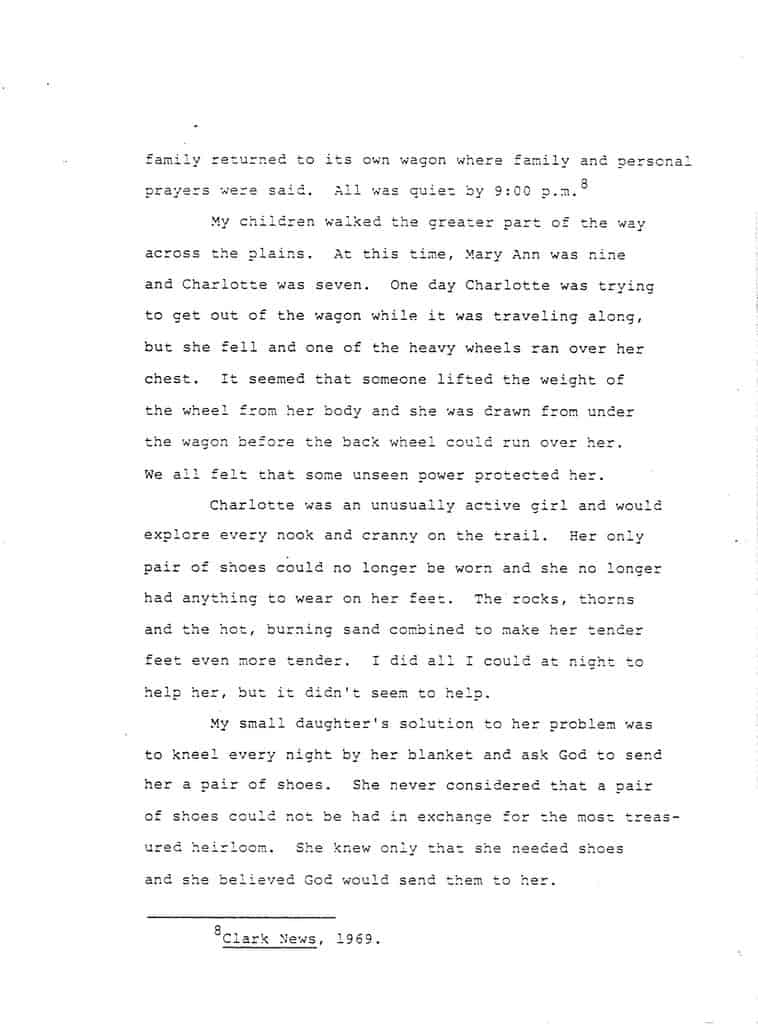
In the spring of 1852 the Clark family began their journey across the plains. Mary Ann, age 9, and Charlotte, age 7, walked most of the way. The trail was dusty, hot and long. They became weary, discouraged and discontented, but day after day they toiled on. Some of their experiences were strange and others exciting. The camp at night was always a big thing in the children’s lives. They thrilled when the wagons were formed in a circle with the tongue of one wagon interlocking in the back axle of the wagon ahead forming a round corral for their stock. The preparation of the evening meal was watched with great excitement as the children were always hungry. The spirit of thankfulness and cheerfulness was almost always present at these meals. After evening prayers the weary group were glad to crawl in their beds. The two girls would huddle in each others arms and shiver when the wolves howled; however they knew guards were always around to watch during the night, so they would rest peacefully. After morning prayer and breakfast they started on their journey again. They realized the danger from the Indians that lurked in the great unknown wilderness, and were amazed at the herds of wild buffalo. Sometimes the advance guards would kill a buffalo or some other edible animal, dress it and bring what they could back for the company to eat. The girls were happy when they came to a creek, where they could get fresh cool water. Mary Ann was old enough to understand the sorrows and trials the pioneers passed through. She witnessed sickness and sometimes death and burial along the way. In latter years when Mary Ann’s children had grown up she would often relate these interesting and thrilling experiences to them. This group of pioneers arrived in Salt Lake City October 10, 1852. The Clark’s came directly to Grantsville where they made their home. None were happier than the two sisters just to know they were at the end of their long and weary journey. Their father constructed a log house with a fireplace where huge logs were kept blazing during the cold weather.
The next year, 1853, Thomas Henry was ordained the first Bishop of Grantsville. He always worked for the betterment and advancement of the community and taught his family to do the same. For a few years Mary Ann attended school. She was a modest, quiet, congenial, pleasant, young woman who was popular in her crowd. In her home she was taught to sew, knit, cook and do general housework. At the age of 24 she married a young Swedish convert, Johannes Anderson (John C. Anderson). The ceremony was performed by Heber C. Kimball on May 4, 1867. Her husband purchased a log building formerly used as a church, and moved the
(Continued from page 26)
usable material to East North street where he constructed a two room log home. Later they built a lean-to addition of two rooms on the south side and a long porch on the north side. They also built a rock cellar just south of the house where they kept their fruits and other foods where it was cool. They dug a well where water could be drawn for the house use and to water livestock. This home is still standing and a daughter, Lillian Anderson Millward resides there.
Mary Ann and John C. were the parents of two sons and seven daughters. Charlotte Rachel (Smith) was born February 20, 1868. Their second child, a son, was born May 20, 1869; he was named John Clark.
No life is complete without its joys and sorrows, and a great sorrow came into the life of these good people in 1872. One day Rachel, age four, and two and a half year old Johnnie were playing in the back yard. Suddenly Rachel ran screaming to her mother that Johnnie had fallen in the water. The mother ran to the well and found that the children had rolled a rock away and had removed a board—her little boy had fallen into the well through this opening. She quickly lowered a ladder into the well and climbed down. She clutched the clothing that floated on top of the water and lifted the little lad to the surface—but she was too late; John Clark Anderson was dead. This tragedy occurred on November 8, 1871. This was a terrible shock to these young parents, but their knowledge of the Gospel and their belief that they would be reunited again brought comfort to them; and as they had always been taught to try and put sorrows and trouble out of their minds and look on the bright side of life, they were brave and looked ahead for future blessings. The other children born to Mary Ann and John C. were: Matilda Ann (Johnson) born February 16, 1871; Hannah Elizabeth (Annie Fiddler) born October 28, 1872; John William, born May 2, 1877 (married Janet Hale). Mary Alice (Johnson) born September 28, 1878; Esther (Halladay) born August 30, 1880; Laura Lillian (Millward) born April 12, 1883; Vendla Amelia (Durfee) born April 11, 1885.
It would be hard to find a family who were more jolly and full of fun; they made a happy home life, being interested in each other’s interests. They were faithful in their church duties, and made many friends at school by their friendliness and spirit of fair play.
The Clark family became true friends of the Indians, and because of their kindness to them they were able to be an influence for good among them. When Mary Ann’s father died the Indians came and wept as they paid their last and great respect to the man whose friendliness had so endeared them to him and his family. After Mary Ann married, her home was visited often by the Indians. On one occasion when the Indians heard that soldiers were coming, they came to take her and her papooses to their wigwams that were hidden in the sage brush, so they could protect and take care of them.
When the Indians from the North passed through here they would take the girl papooses from other tribes and sell or trade them to white people. One day an Indian woman came to the home of Mary Ann and asked if she and baby could hide in her house. She was given permission to do so. The squaw took the quilt Mary Ann handed her, and spread it under the low curtained bed, then she and her baby crawled under, where they stayed for a day and a night. After the Northern Indians left, the Squaw with her babe returned to their home in Skull Valley.
Mary Ann was not a public woman, yet she accomplished much good in her quiet way. She always appreciated and enjoyed her family and friends. She had a loving disposition, a refreshing sense of humor, and an understanding heart. The poor and needy always found a friend in her. She was slow to anger, generous to a fault, tender hearted and forgiving. She always underestimated her abilities. Her work was made lighter by the gay songs she sang as she labored. To her husband, who suffered for many years with rheumatic condition in his legs, her devotion was outstanding.
In 1906 another tragedy struck their lives. Their daughter Matilda Ann (Till) died May 16, 1906, leaving three sons and two daughters motherless. A short time after Till’s death, her husband Charles Albert Johnson died March 15, 1910—leaving the children orphans, Till’s sister Alice and husband Alex Johnson (Alex being a brother to Charles) took the children, Maude Clarice, Charles Wallace, John Stanley, Mary Alida, and George McCoy, into their home and raised them as their own children. This noble act of Alice and Alex filled Mary Ann’s heart with gratitude and joy.
Mary Ann also endured the sorrow of the passing of her beloved husband on June 4, 1912, and to make her just a little more lonely her son, John William, was in Sweden on a mission all through her husband’s illness and death. The family learned that John William was released and on his way home before his father died, and it was hoped by everybody that he would reach home in time to talk to his father, but that hope was destroyed as his father died at 11 pm. June 4, 1912, at the age of 76 years, 4 months. Twelve days later his son arrived home. He did not know his father was dead until he arrived in Salt Lake City. Maroni England, the county’s first undertaker came to Grantsville and embalmed May Fredrickson in the forenoon and John Anderson in the afternoon on the day of their deaths. This made it possible to keep the body until John William arrived home. The funeral was held the following day, June 16, 1912.
Mary Ann was always faithful to her church duties and was a Relief Society visiting teacher for many years. She was 71 years and 7 months old when she died on January 11, 1917—just 4 years and 7 months after the death of her husband. Her body was prepared for burial by her daughter-in-law, Net Anderson and Mrs. Rose Hammond; and she was laid to rest by the side of her husband.
Her posterity is numerous, many of whom knew her personally. To know her was to love her.
—Written by Janet Hale Anderson, a daughter-in-law. A few excerpts taken from history written by Helen Ann (Nellie) Smith Orr—a granddaughter.
From Pages of the Past
Transcript-Bulletin, Jan. 18, 1917
Grantsville Pioneer Passed Away Friday
Mrs. Mary A. Anderson, relict of the late John C. Anderson passed away very suddenly at the home of her daughter, Mrs. John E. Millward at Grantsville, shortly after midnight Thursday night.
Mrs. Anderson whose health had been poor for the past few months had gone to bed as usual, telling her granddaughter (Chleo Fiddles) who was taking care of her while her mother was attending the Old Folks Sociable, that she was all right and did not need watching. When Mrs. Millward returned from the Sociable, she went to the room to see how mother was, when she found that she had passed away peacefully while asleep in bed.
Mary Ann Clark Anderson was the daughter of Bishop Clark and was born at Nauvoo, Illinois, on March 28, 1843. She came to Utah in 1853, coming direct to Grantsville with her parents who were one of the first eight families to settle in the town. Three families settled there in 1852, and five more in 1853, of which Bishop Clark’s was one.
The deceased is survived by seven children, one son, Bishop John William Anderson of Grantsville Second Ward, and six daughters, Mrs. Joseph W. Smith, Mrs. Philip Fiddler, Mrs. Alex Johnson, Mrs. Robert D. Halladay, Mrs. John E. Millward, and Mrs. Frank Durfee, all of whom reside in Grantsville.
She is also survived by 35 grandchildren and 8 great grandchildren.
The funeral services will be held Sunday afternoon at one o’clock, probably in the First Ward Chapel.
(1960) Mrs. Halladay and Mrs. Millward are only survivors.
Source
The Clark News Vol. 2, No. 7
- Added
- November 7, 2026